
Criminal Court Cases in Adair County
Iowa uses a unified district-court system. In Adair County, the Iowa District Court hears indictable criminal cases, including felonies and aggravated or serious misdemeanors. Magistrate jurisdiction covers simple misdemeanors and preliminary matters within that same system. There is no separate county-clerk and district-clerk split. The Adair County Clerk of District Court is the local custodian for the docket, filings, financial entries, orders, judgment, and sentence.
City enforcement can start an ordinance or criminal matter, but no distinct Greenfield, Stuart, or Fontanelle municipal case-search database was verified. Once a case is filed in Adair County, use the state search and the district clerk. The official Adair County courts page shows where that clerk operates. Its captured view below helps identify the correct local office, and the clerk remains the source for an official copy.
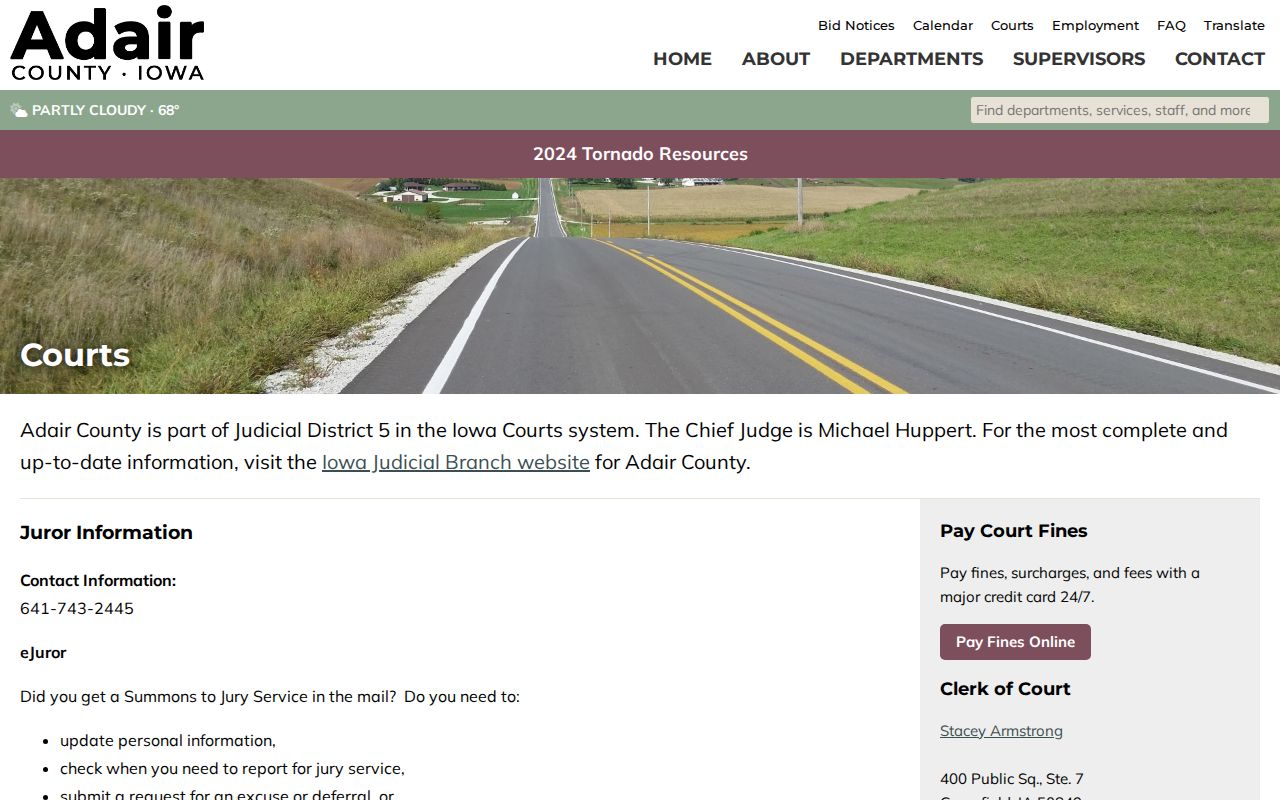
The local court page matters because a statewide search result can point to a case without supplying every public document in the file. The official Adair County homepage also publishes countywide courthouse hours and closure notices that can affect an in-person request.
Adair County Court Clerk Counter
The clerk counter is in suite 7 on the second floor, west side of the Adair County Courthouse at 400 Public Square, Greenfield, IA 50849. Published clerk hours are Monday through Thursday, 8:00 a.m. to 4:30 p.m., and Friday, 1:00 to 4:30 p.m. Call 641-743-2445 before a trip if the request involves an older file, a certified copy, or a document that does not appear online. Parking is available around the courthouse and on nearby streets.
Give the clerk the exact Adair County case number when possible. A name, approximate filing year, charge, and party role can help locate a file when the number is unknown. Ask for the docket first, then identify the complaint, trial information, order, judgment, or sentencing entry needed. The state court guide reports a $0.50-per-page copy benchmark, but current search and certification charges should be confirmed locally.
The Iowa Judicial Branch court-forms page supplies current forms for court business. The image below marks that official forms channel, which is safer than relying on an old downloaded copy.
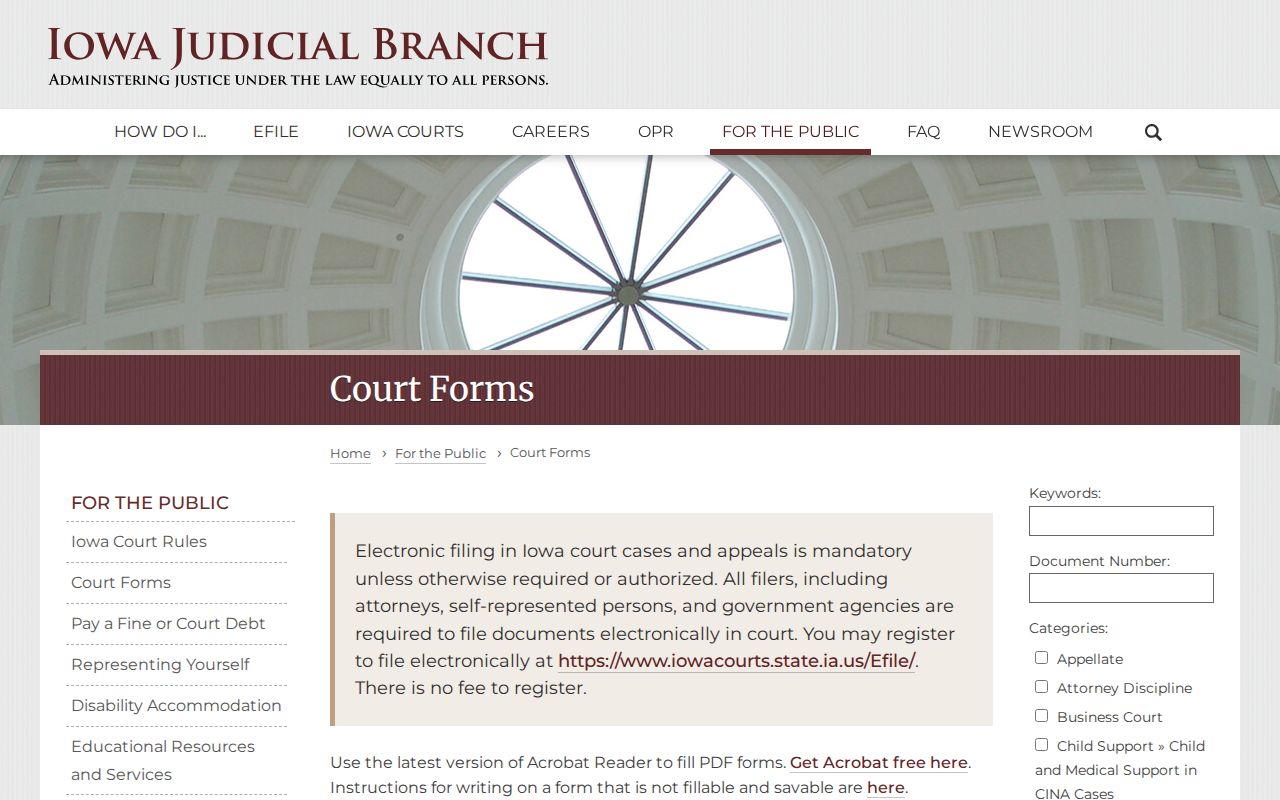
Forms support a filing, while the Adair County clerk can confirm which form and case number apply to an existing docket.
Adair County Case Record Searches
Iowa Courts Online Search is the first public discovery channel for an Adair County criminal case. Search by case number when available because it is the strongest identifier. A name search can work, but spelling, middle names, and same-name parties require care. The portal warns that its display is not the official certified court record.
- Open Trial Court search and select Adair County to keep results tied to the local district court.
- Enter the case number, or use the party's last and first names when the number is unknown.
- Narrow by case type or other fields shown in the live interface, then compare names and case IDs carefully.
- Open the summary and record the case ID, charges, status, events, disposition, and financial entries.
- Contact the Adair County clerk for named documents, older material, plain copies, or a certified record.
| Field Label | Type | Required | Notes |
|---|---|---|---|
| Search Type | Tab or menu | Yes | Choose the trial-court option for Adair County filings. |
| Case Number | Text | No | Use the Iowa case-ID format when known. |
| County | Dropdown | No | Select Adair to narrow the result set. |
| First, Middle, Last Name | Text | No | Spelling and middle-name detail can separate similar names. |
| Case Type | Dropdown | No | Available criminal, traffic, and other options vary by interface. |
The image below comes from the official Iowa Courts Online interface. It shows the correct statewide starting point without exposing a private person's case.
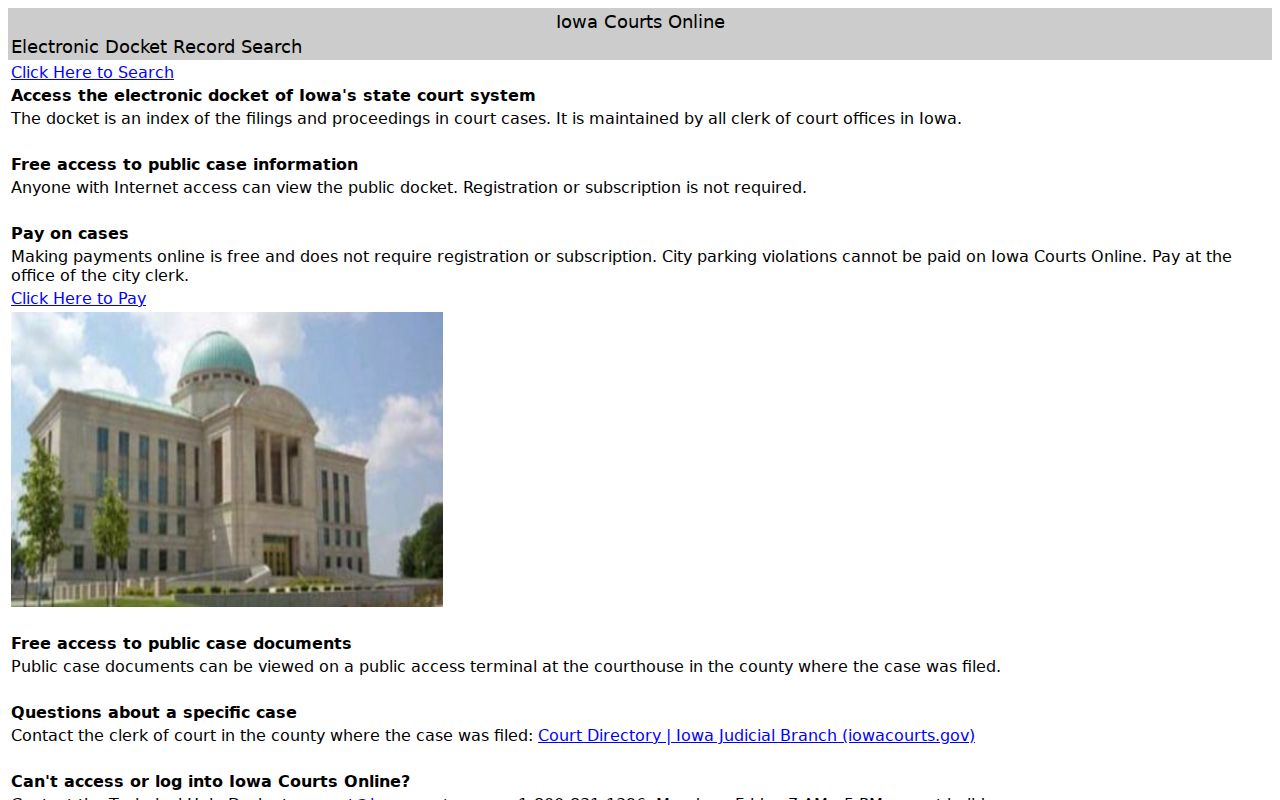
Use the live fields shown at search time, then verify any Adair County result against the clerk-held file.
Adair Online Cases Need Verification
Online case data can be current enough to locate a docket yet still fall short of what a reader needs. An event line may name a filing without displaying its image. A charge can change after the first complaint. Each count may end differently, so a top-level status cannot substitute for the count-by-count disposition. Older or converted documents may also require clerk retrieval.
When an Adair County case seems absent, check spelling and county selection before assuming no file exists. Then ask the clerk whether the case is older, archived, converted, confidential, or indexed under another case number. Juvenile files, sealed material, protected victim data, and other confidential records do not become public merely because a request is made. The clerk can explain access procedure but cannot give legal advice.
What a Criminal Case File Contains
An Adair County court case file follows the filed prosecution rather than the jail intake. The most useful records are often the charging document, docket, order resolving each count, and judgment or sentencing entry. Financial fields may show fines, costs, surcharges, restitution, and payment activity where public. Full sensitive identifiers and confidential case categories are withheld or redacted.
| Case Number and Court | Identifies the Adair County case, Iowa court, case type, filing date, and public status. |
|---|---|
| Charging Document | Shows the complaint, trial information, or indictment and the formal allegations filed. |
| Docket Entries | Lists filings, appearances, hearings, pleas, orders, warrants when public, and judgment events. |
| Parties and Attorneys | Names the State, defendant, and public attorney appearances in the case. |
| Disposition and Judgment | Records the outcome and date for each count, including dismissal, plea, verdict, or deferred judgment. |
| Sentence and Financials | Shows the court's sentence and public fine, cost, restitution, or payment entries. |
A booking charge is only the allegation recorded at intake. For the later filed charge and outcome, follow the Adair County arrest trail into the court docket.
Decode Adair Criminal Case Prefixes
Iowa case prefixes identify the kind of criminal matter, not its outcome. FECR is used for felony criminal cases. AGCR points to an aggravated-misdemeanor criminal case, SRCR to a serious misdemeanor, and SMCR to a simple misdemeanor. The prefix helps a reader sort results and understand court jurisdiction, but it never proves guilt or says how the charge ended.
- Docket
- The dated list of filings, hearings, orders, and other case events.
- Trial information
- An Iowa prosecutor's formal charging document for an indictable offense.
- Disposition
- The outcome of a case or an individual count.
- Deferred judgment
- A judgment held back while a person completes court-ordered conditions.
Read the charge description, offense level, disposition, and disposition date together. “Dismissed” is not “convicted,” and a deferred judgment is not the same as a dismissal. The Iowa Judicial Branch's 2025 court-system guide reflects the current electronic search and filing structure, while the official case-ID guide controls abbreviations.
Criminal Case Stages in Adair County
A filed Adair County prosecution usually begins with a complaint and initial court processing. For an indictable offense, a trial information or indictment states the formal charge. Arraignment records the plea. Pretrial motions and negotiations can reshape the issues before a plea or trial, and judgment follows the resolution of each count. Sentencing sets the punishment and other terms after a conviction.
Case flow: Charges Filed › Arraignment › Pretrial › Plea or Trial › Disposition › Sentencing
The Adair County Attorney prosecutes state-law and county-ordinance violations. The official County Attorney page identifies that local role and office. Its image below helps separate the prosecutor, who files and litigates charges, from the clerk, who maintains the case record.
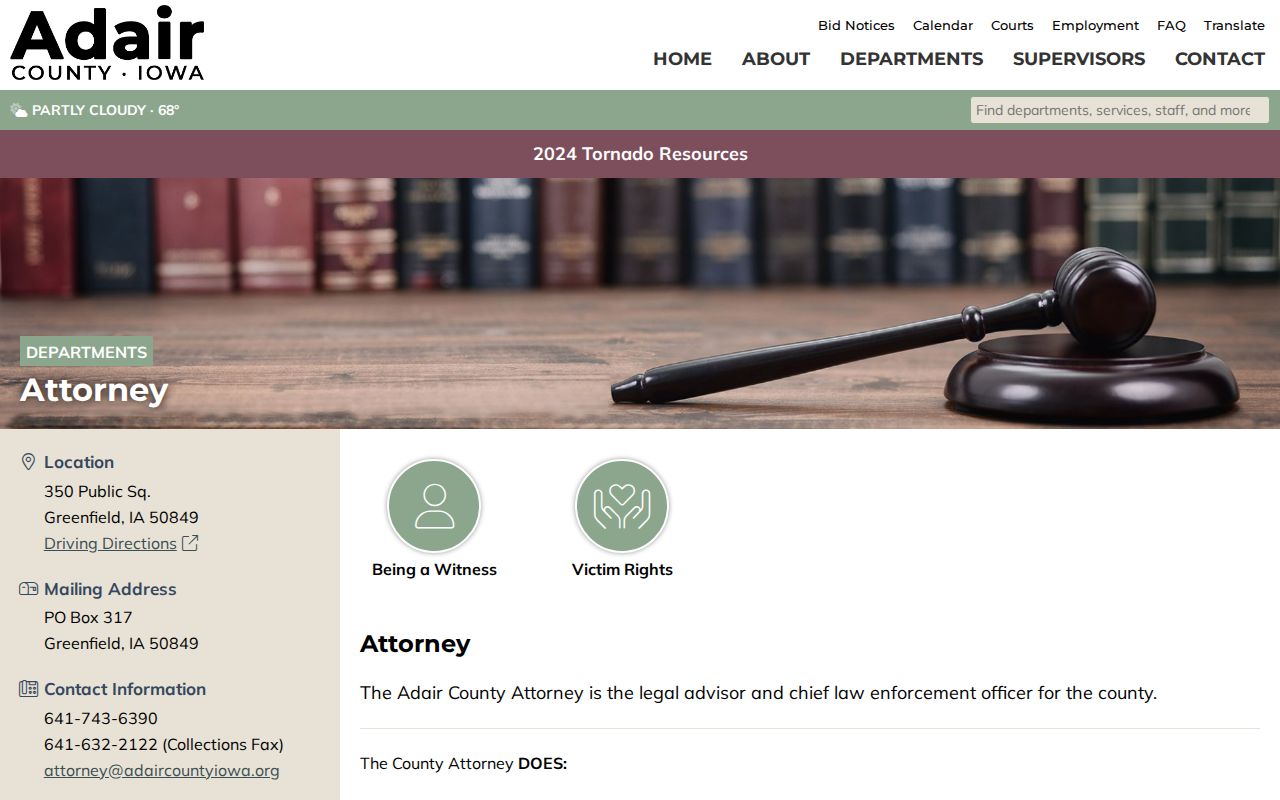
The prosecutor does not replace the clerk as the source for the public docket or a certified Adair County court record.
EDMS and Adair Court Documents
Electronic filing and public case search are related but not identical channels. Iowa Courts Online supplies basic public case discovery. The Electronic Document Management System, or EDMS, has an account sign-in for filing and authorized document access. A public docket may list a document even when its image is not open through the basic search.
The official EDMS sign-in is shown in the image below. The account gate explains why seeing an Adair County docket entry does not always mean the linked filing can be opened anonymously.
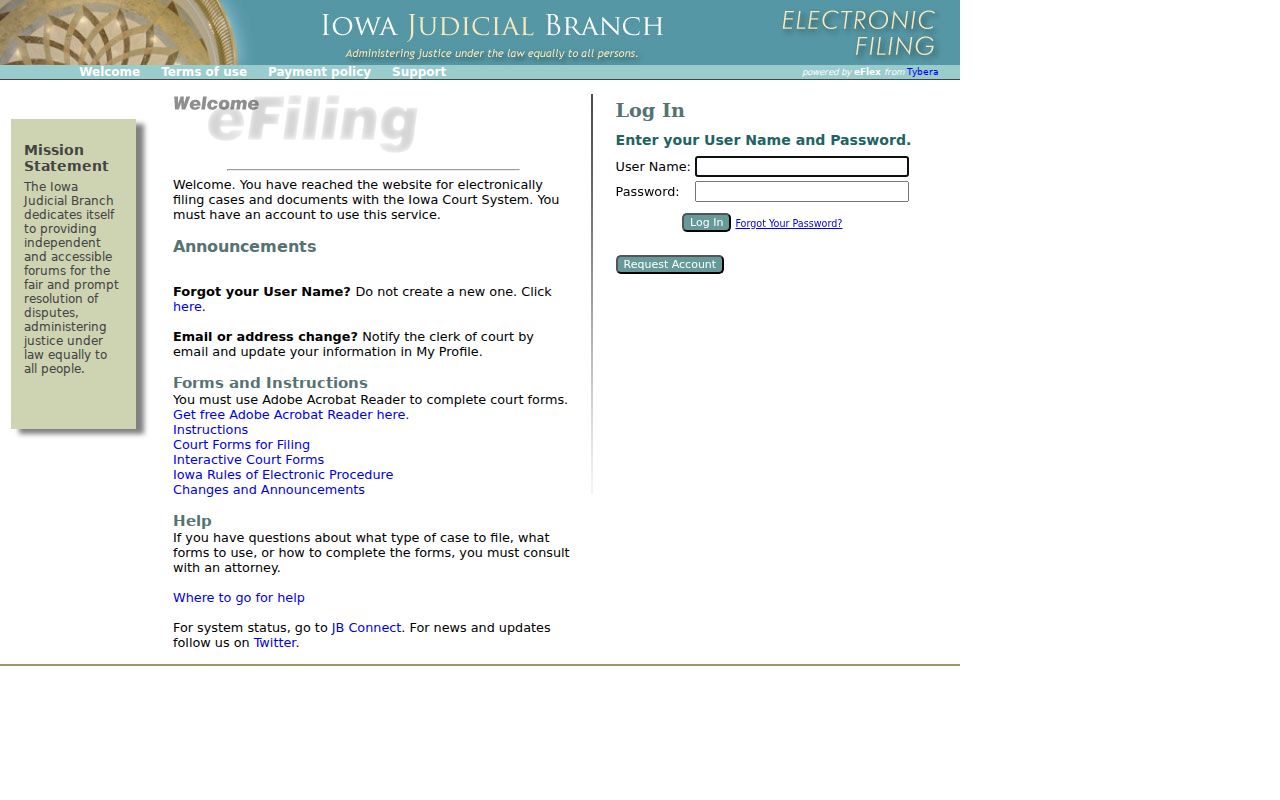
If EDMS does not provide the needed public item, give the Adair County clerk the case number and exact document title rather than requesting the entire file without a clear need.
Access Rules for Case Records
Iowa Code chapter 22 supplies the general inspection and copying framework, but it does not override specific confidentiality rules. Juvenile matters, sealed or expunged files, victim identifiers, medical information, and full personal identifiers can be restricted. Unexecuted warrants and protected investigative material may also be absent from a public view.
Iowa Code chapter 692 governs criminal-history dissemination and a subject's challenge rights, while chapter 901C addresses qualifying expungement. Those repository and relief rules are not a reason to expect every Adair County docket entry to be public. Ask the office that holds the source record, and narrow the request to a case number, document, and date range.
Missing Adair Court Case Records
A blank online search can have several causes. The filing may be too new to appear, too old for complete electronic coverage, indexed under a different spelling, assigned to another county, or subject to a confidentiality rule. Start with the exact case number or citation number. Repeat the search with Adair County selected and check the Iowa case prefix.
If the case remains missing, call the clerk and ask whether an archived or converted record must be retrieved at the counter. Preserve the search terms and note the result date. For a record that appears wrong, compare the docket with the underlying order or judgment before asking the source office about correction. Do not infer an outcome from silence in one database.